
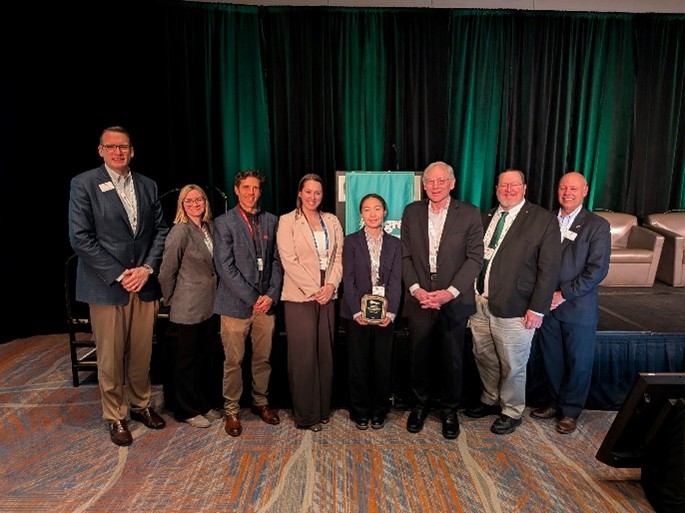
Ruoyan Fan wins 2025 NGN Paper Competition
 |
| Ruoyan Fan |
Ruoyan Fan was named winner of the 2025 NGN Paper Competition for the paper “A Room-Temperature Quantum Secure ROCOF for Power Grid Reliability,” co-authored with Z. Jiang, P. Zhang, Y. Shamash, K. Sanjani, K. Shahare, and W. Krawec (Stony Brook University and University of Connecticut). The following is the synopsis of the winning paper.
The increasing penetration of inverter-based resources reduces system inertia and makes modern power grids more vulnerable to rapid frequency deviations. Under these conditions, the rate of change of frequency (ROCOF) becomes an important protection indicator. However, current ROCOF protection relies on IEC 61850 GOOSE communication, which contains security vulnerabilities in its communication channel.
To address this challenge, we propose a room-temperature quantum-secured ROCOF framework that integrates quantum key distribution (QKD) with GOOSE messaging. QKD-derived keys are applied to hash-based message authentication codes (HMACs), enabling dynamic authentication of ROCOF-based trip signals and ensuring their integrity against adversarial manipulation.
The framework was validated on a hardware-in-the-loop test platform using a modified NPCC system. Experimental results show that man-in-the-middle (MITM) attacks on GOOSE traffic, which can suppress legitimate trip signals and destabilize the system, are reliably detected and rejected using the proposed protection architecture. In addition, attempted eavesdropping on the quantum channel is revealed through elevated quantum bit error rate (QBER), preventing the use of compromised keys in the protection channel.
This work provides experimental demonstrations that room-temperature QKD can be practically deployed in grid protection, enhancing both cybersecurity and operational reliability in low-inertia power systems.