
C.N. Yang
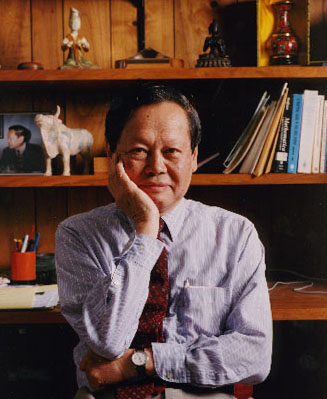 Late Prof. C.N. "Frank" Yang: 1922-2025
Biography
Chen Ning "Frank" Yang was born in Hefei, China in 1922. His childhood was spent primarily at Tsinghua University, where his father was professor of mathematics. In 1939, however, the war between Japan and China forced his family to relocate to Kunming in Yunnan Province. In Kunming, he earned bachelor and masters degrees in physics from the Southwest Associated Universities. Although isolated by war, Yang recounted that his education in Kunming set much of his style of physics research and prepared him more than adequately for his further graduate study, which he continued in 1945 on a fellowship at the University of Chicago. At Chicago, Yang worked with Enrico Fermi, and graduated as the student of Edward Teller in 1949. He then took a postdoctoral position at the Institute for Advanced Study, where he rose to permanent membership by 1954, on the basis of fundamental advances in statistical mechanics and the then-new area of elementary particle theory. On sabbatical at BNL in 1954, he and Robert L. Mills developed and published the first non-abelian gauge theory. Such Yang-Mills theories have subsequently been recognized as the foundation of the current Standard Model of fundamental matter and forces. In 1956, Yang and Tseung-Dao Lee proposed unprecedented tests of parity, or reflection, symmetry in a class of nuclear and particle radioactive decays. The thunderbolt result that parity symmetry is violated in weak interactions earned Yang and Lee the 1957 Nobel Prize in physics. As the first Chinese Nobel laureates, this recognition carried special weight.
In 1966, Yang left the "ivory tower" of the Institute for Advanced Study at Princeton, moving with his family to the State University of New York at Stony Brook, still very much under construction in every sense. At Stony Brook, he assembled two generations of faculty at the Institute for Theoretical Physics, and helped guide the development of the Department of Physics, which became Department of Physics and Astronomy. Highlights of his Stony Brook research include the Yang-Baxter equation, a landmark in the treatment of physics theories in two dimensions, extensive work in high energy particle collisions, and, growing out of conversations with James Simons, recognizing and initiating the exploration of the close connection of gauge theories with the mathematical concept of fiber bundles. In this period, he also brought his international stature to bear on opportunities for scientific and educational relationships between the United States and China, and on encouraging the reemphasis of scientific scholarship within China. Retiring from Stony Brook in 1999, he moved back to Tsinghua University in 2003, where he continued his aim of developing theoretical physics in China, while reflecting in print on historical highlights in the development of science. His death in 2025 at the age of 103 marked the close of an era.
Late Prof. C.N. "Frank" Yang: 1922 - 2025