
andrew rimby '23 PHD
Department of English
Fall 2018 Inaugural Recipient
It’s All Wilde to Me: A Journey into the Oscar Wilde Collection
When Andrew Rimby began studying Oscar Wilde and Walt Whitman, he was drawn to a question that has lingered for more than a century: what really passed between the two poets when they met in Camden, New Jersey, in 1882?
The motive behind Wilde’s desire to meet with Whitman was to learn how to make a name for himself and learn the art of self-promotion from one of the greatest American literary celebrities. A few days after the meeting, Wilde wrote to his friend George Ives, an early advocate of queer rights, that “the kiss of Whitman was still on his lips.” The sexual nature of the meeting between Whitman and Wilde is ambiguous, but the press and literary community continued to speculate what had occurred during the meeting as Whitman and Wilde had drank elderberry wine without anyone else around.
With support from the Giuliano Fellowship, Andrew travelled to the British Library to immerse himself in the Lady Eccles Oscar Wilde Collection, one of the most significant Wilde archives in the world. He hoped to uncover letters between the two poets and trace how ancient Greek culture, Hellenism, shaped their shared aesthetic of male homoerotic desire.
The Secret Key to Whitman and Wilde’s Relationship
“This is the part where I disclose that my utopic quest to find extensive letters exchanged between Whitman and Wilde did not occur.” The letters never surfaced, but the archive had more in store for Andrew.
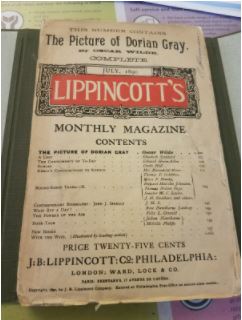
In March 2019, Andrew presented “The Poisonous Yellow Book in The Picture of Dorian Grey” at NeMLA, as an excerpt from his dissertation chapter, which offers a queer theoretical analysis of Wilde’s novel.
The Picture of Dorian Gray 1890 first edition, courtesy of the British Library
He had already examined how scholars approached the male homoerotic encounters in The Picture of Dorian Gray, but one question remained unresolved: Why had Wilde become so invested in ancient Greek literature and language in the first place?
The question followed him into the archive as Andrew encountered journals and unpublished manuscripts that revealed the depth of Wilde’s fascination with ancient Greece. Tracing the timeline back to 1871, when Wilde began his undergraduate studies at Trinity College, Dublin, he observed how Wilde’s immersion in Classics introduced him to Hellenism—the culture, literature, and language of ancient Greece. Wilde excelled in these studies, winning the Berkeley Gold Medal in Greek during his finals.
Among the discoveries was a manuscript titled “Hellenism,” which articulated Wilde’s belief in a unifying “spirit” within Greek thought and art. Studying Wilde’s handwritten texts, Andrew began to see that Hellenism functioned as more than an academic interest. It operated as a coded language within Victorian literary circles, a framework through which same-sex desire could be expressed through the aesthetic and philosophical vocabulary of ancient Greece.
A Transatlantic Project Deepens
The manuscript led him to develop a broader transatlantic study of how Whitman’s poetry was interpreted through a Hellenic lens within Wilde’s circle.
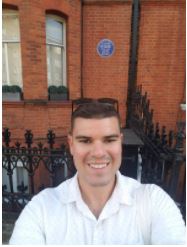
“Travelling to The British Library, thanks to the Guiliano Fellowship, has helped me chart out my dissertation project and see the stakes of my project in a clearer light.” says Andrew.
The Giuliano Fellowship did more than fund archival research. It allowed Andrew to step into one of the world’s most significant literary collections and clarified the stakes of his scholarly journey. Andrew is now transcribing Wilde’s “Hellenism” manuscript and hopes to publish it in an upcoming essay.
Rimby in front of Oscar Wilde’s flat in Chelsea
The Guiliano Global Fellowship Program offers students the opportunity to engage in
research, creative expression, and cultural activities for personal development by
travelling outside their comfort zone.
GRADUATE STUDENT APPLICATION INFORMATION
UNDERGRADUATE STUDENT APPLICATION INFORMATION
Application Deadlines:
Fall deadline: October 1 (Projects will take place during the Winter Session or spring semester)
Spring deadline: March 1 (Projects will take place during the Summer Session or fall semester)
Please submit any questions here.